
Hardware goods are used in practically every industry, including household construction, furniture, industrial equipment, and commercial buildings. Although the finished product receives the most attention, the material used in manufacturing has a significant impact on its strength, appearance, durability, and machinability.
Selecting the correct metal for hardware manufacturing is more than just choosing a robust alloy. Manufacturers must consider corrosion resistance, ease of manufacture, surface finish, wear performance, and long-term reliability to ensure that each component performs as intended.
Material Selection Influences Product Performance
Each hardware component is intended to perform a certain function. Some parts require extreme strength, while others prioritize attractiveness, corrosion resistance, or precision machining.
When choosing a metal, producers usually consider factors like:
- Mechanical Strength
- Corrosion Resistance
- Machinability
- Weight
- Surface finish.
- Cost efficiency
Balancing these features helps ensure that the finished gear operates consistently across its service life.
Brass Remains a Popular Option for Precision Hardware
Among the different materials available, brass remains one of the most commonly used metals for hardware fabrication. Its high machinability, beautiful look, and corrosion resistance make it ideal for both functional and decorative purposes.
Brass is widely used for:
- Cabinet Knobs and Pulls
- Door hardware
- Fasteners
- Decorative trim.
- Threaded fittings.
- Precision-machined components
Its ability to create clean threads and crisp edges makes it an ideal choice for high-volume machining operations.
Bronze Offers Excellent Wear Resistance
Bronze is frequently used in hardware components that are subjected to constant movement or friction due to its endurance and wear resistance.
Bronze is often used in:
- Bushings
- Bearings
- Spacers
- Pivot components
- Heavy-duty hardware
These qualities make bronze particularly attractive in situations where long service life and consistent mechanical performance are critical.
Manufacturing Processes Also Affect Material Choice
Different production procedures necessitate materials with distinct properties. Choosing stock forms that are appropriate for the manufacturing process can increase efficiency and save waste.
Common material types include:
- Rod and bar for milling.
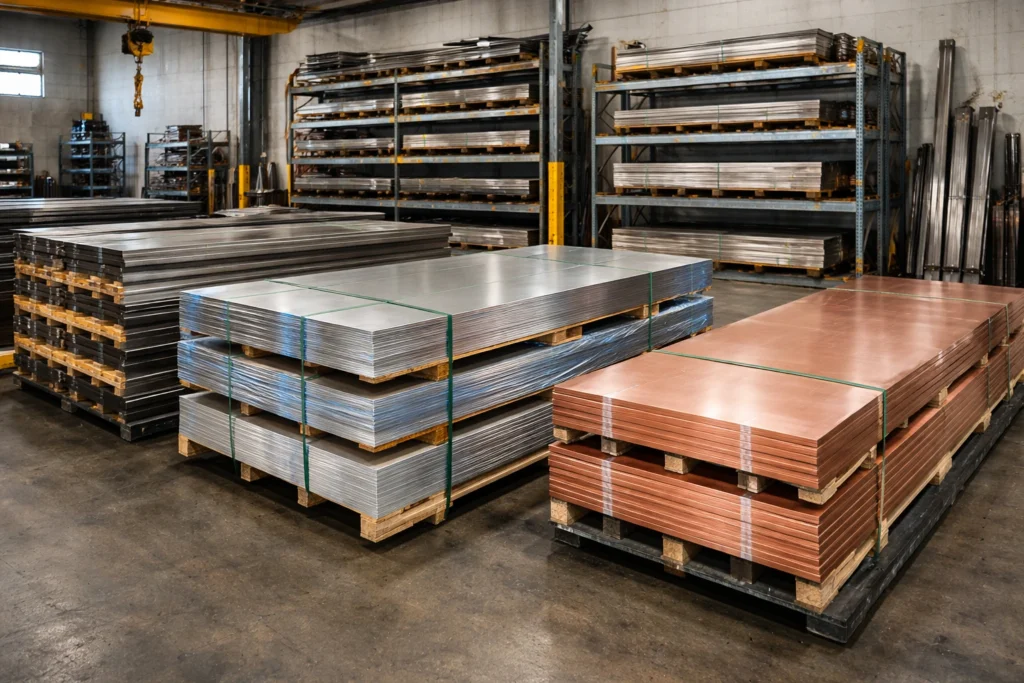
- Sheet and plate for fabrication.
- coil for stamping
- Tubing for structural components.
- Architectural shapes for customized assemblies.
Using the suitable stock form ensures consistent dimensions and smoother manufacturing procedures.
Surface Finish Can Enhance Product Quality
For many hardware goods, look is equally crucial as functionality. Components utilized in residential, hospitality, and commercial environments frequently demand smooth, visually pleasing finishes.
Manufacturers often consider materials that support:
- Polishing
- Brushed finishes.
- Decorative coatings.
- Precision detailing
- Consistent surface quality
Choosing a metal that responds well to finishing techniques can improve the final appearance of the product.
Consistent Material Supply Supports Production Efficiency
Maintaining consistent quality throughout production runs is critical for businesses who produce big quantities of hardware.
Reliable material providers might assist by offering:
- Consistent alloy quality.
- Standard stock sizes.
- Precision-cut materials.
- Custom dimensions.
- Fast order fulfillment
Having reliable access to materials reduces production delays and promotes efficient manufacturing schedules.
Custom Material Options Help Meet Specialized Requirements
Not all hardware applications meet standard specifications. Some manufacturers demand special alloy compositions, specialized profiles, or non-standard dimensions to meet product specifications.
Working with providers who provide custom processing services can help assist initiatives that require:
- Special Mill Orders
- Custom Tubing Profiles
- Precision Cutting
- Polishing Services
- Specific tempers and metal grades.
These capabilities enable producers to source materials that are more closely aligned with their manufacturing aims.
Matching the Material to the Application
There is no general solution for selecting a metal for hardware fabrication. The optimum material is determined by the component’s intended use, production technique, and desired performance characteristics.
Corrosion resistance, machinability, durability, and finish quality are among elements that manufacturers consider when selecting materials that suit both functional and aesthetic needs.
Final Thoughts
Selecting the appropriate metal for hardware manufacture is a critical decision that affects product quality, manufacturing efficiency, and long-term performance. Whether making decorative hardware, architectural components, or precision-machined parts, choosing the right brass or bronze alloy will help you achieve consistent and reliable results.
Lewis Brass & Copper provides a wide range of high-quality brass, bronze, and copper products. With precise processing services and decades of industry knowledge, they offer material solutions for a wide range of hardware manufacturing applications.


More Stories
Unlocking the Hidden Levers: 5 Unconventional Strategies to Skyrocket Your Business Growth
The Future-Proof Business: Thriving in the Age of AI and Disruption
Crafting Tomorrow: Innovative Business Strategies to Outpace the Competition